Put up or shut up
Take a few moments to read this article in the Alaska Dispatch, written by Craig Medred.
Wednesday, February 10, 2010
Alaska; The Last Frontier


 Born in a small coastal town in British Columbia, Canada where the only way in or out was by boat or seaplane, I never stood a chance. My destiny was a forgone
conclusion. I was doomed to fish and fly as soon as I was able. After a stint as a pilot in the Royal Canadian Navy in the sixties, and after 34 years as an airline pilot with a major U.S. carrier, at seventy five years old I am still fishin' and flyin'. More about all that as we go, if anyone is interested
Born in a small coastal town in British Columbia, Canada where the only way in or out was by boat or seaplane, I never stood a chance. My destiny was a forgone
conclusion. I was doomed to fish and fly as soon as I was able. After a stint as a pilot in the Royal Canadian Navy in the sixties, and after 34 years as an airline pilot with a major U.S. carrier, at seventy five years old I am still fishin' and flyin'. More about all that as we go, if anyone is interested
Friday, January 15, 2010
The answer to the Alaska Christmas Gift Quiz

Did you guess the significance of the Alaska Christmas Gift?
Well...it's a Cartridge in a Bare Tree.
Hope you had a Merry Christmas!
Captain Mac
Born in a small coastal town in British Columbia, Canada where the only way in or out was by boat or seaplane, I never stood a chance. My destiny was a forgone
conclusion. I was doomed to fish and fly as soon as I was able. After a stint as a pilot in the Royal Canadian Navy in the sixties, and after 34 years as an airline pilot with a major U.S. carrier, at seventy five years old I am still fishin' and flyin'. More about all that as we go, if anyone is interested
Thursday, January 14, 2010
Winter Days at the Lodge

Misty Winter Morning
in Saltery Cove
in Saltery Cove
This Christmas season the weather has been just the opposite of last year. We have had little or no snow, and balmy temperatures during the day (all the way up in the mid-40's some days) and clear, crisp nights down into the 20’s. The last few days of December were gorgeous and I couldn't help capturing some images to share with you.
Our floating dock, and that of our next-door neighbor’s, are ecosystem unto themselves. They shelter schools of baitfish, mussels, flowing seaweed, worms, hundreds of small shrimp, crabs, sea cucumbers, several varieties of starfish and many other forms of marine life at the lower end of the food chain.

This living banquet attracts all kinds of critters and today they all showed up, well all except our resident mink population, much to my disappointment. But those guys will probably show up soon for their daily foraging so I'll likely catch them with the camera then. For sure we will hear them at night, squealing and screeching like a bunch of alley cats.
The fish ducks, or sea ducks as they are more commonly called are everywhere, and they come in many shapes and sizes, mostly Mergansers and Goldeneyes and Scoters with a few Buffleheads and the odd Harlequin thrown in.
They paddle around with their heads underwater in search of their prey, and as if on signal, they disappear all at once in a splash and pop up a few seconds later, usually with a small fish wiggling in their mouths.

Where are they? There's fish down there somewhere.
And the seals are also drawn by the action. We have a couple of regulars that hang out around the dock, and at high tide, come within a few feet of the deck on our home.

"The Wierd One" cruising upside down under our deck
The water is so clear we can easily see them chasing the baitfish underwater, zooming and turning and twisting with incredible grace and fluidity.We have one that we call “The Weird One” that cruises around upside down with just his tummy and his nose and chin above water. In this position he is able to breathe while he scans what is below and ahead of him in the water

One right side up (top) and "The Wierd One" upside down
And of course there is Hank. Hank Heron, that is. Yes, the play on words and reference to the famous ball player is deliberate. It just fits somehow, kinda flows together naturally.
Hank is amazing for his patience. He will stand absolutely motionless for hours on end at the water’s edge or on a log or at the end of the dock. He becomes part of the landscape so you are not even aware that he is there. And as you approach him he will let out a mighty squawk in protest and launch his huge frame into the air scaring the wits out of you!

Hank on our neighbor's dock line.
He will stand there motionless by the hour.
Today he was working the beach. Evidently the baitfish were along the shoreline. I couldn’t see them but Hank could. He would stand in a few inches of water, in his statue-like pose.

Standby......ready....
You could tell when the school of fish were coming within killing range because he would cock his head ever so slightly, and very slowly lower his head, taking aim, then – Bam! He would strike, and invariably come up with a small fish in his sharp beak. He was deadly!

Bam!


Gotcha!

Then the fun started. There was a family of nine altogether, Mom and Pop and seven teenagers, rolling in the snow, running and sliding, and finally all ending up in an “otter ball” piling on top of one another and rolling around in a furry heap of heads and arms and legs and tails in the snow. They were having a blast! Every so often one or two would peel off and dive under the dock, coming up with mussels and other goodies that they sometimes shared with the rest. This went on for a half hour or more. I wished I had a telephoto lens.
So what did we need to top off this perfect scene as the day ended? Why a full moon of course.
What an incredible place we live in, even in winter.

Moonrise - New year's Eve, 2009
May you have a blessed 2010!
Captain Mac
Born in a small coastal town in British Columbia, Canada where the only way in or out was by boat or seaplane, I never stood a chance. My destiny was a forgone
conclusion. I was doomed to fish and fly as soon as I was able. After a stint as a pilot in the Royal Canadian Navy in the sixties, and after 34 years as an airline pilot with a major U.S. carrier, at seventy five years old I am still fishin' and flyin'. More about all that as we go, if anyone is interested
Jonathan Bender's Cape Chacon - Part II

Sunrise at the Lodge.
Deckhands start their day
If you haven't read Part I yet, go ahead and do that now, so you can pick up the thread. My apologies for being so long between posts, but Christmas and all that...
Looks like it will take at least one more posting in addition to this one to finish up Jon's story. Hope you enjoy it.
Captain Mac
Looks like it will take at least one more posting in addition to this one to finish up Jon's story. Hope you enjoy it.
Captain Mac
++++++++++++++++++++++
For the past two months I had made my home on another obscure cove, tucked into the eastern side of Prince of Wales Island. There, I’d developed and kept a nearly uninterrupted routine for 64 consecutive days. I’d crawled from my bunk each morning at 4:30 to eat breakfast and prep the boat; spent the day tying lines, baiting hooks, checking gear, chit-chatting, netting fish, hosing off and scrubbing the boat, filleting fish, chit chatting, pulling hooks out of my hands, filleting fish, cleaning the boat, and… filleting more fish, before crawling into bed at around 7. But I enjoy that stuff; helping people have a good time. Otherwise, why would I take the extra time to whip up some wasabi for the fresh, halibut cheek sashimi when there’s a successful catch to celebrate? Why would I go through the trouble of snelling my own rigs when there are pre-tied ones available (with duller points and that tacky nickel finish)? It’s kind of like taking a friend to a movie you’ve already seen, enjoying their reactions to your most memorable scenes, maybe feeding their excitement beforehand. So, all this drudgery, it’s all the cost of being able to offer what I offer, and in such a wonderful setting. A powerful experience awaits every morning, not just for the guests, but for me too. We have access to this spectacular place where so few people ever venture. It’s just the Inside Passage, raw nature, and our little fleet of four. This is the thought that goes through my mind as we motor out of Gardner Bay this morning This is what fuels me, and I’m all too eager to share this world with anyone willing.
This is a particularly fun group. They’re after the experience, as opposed to those unfortunate ones, the people that come for a $3000 box of meat. These guys, three father/son teams, are wonderful, enthusiastic, and they’re having a great time. The group of six had grown close over the previous two days, and they’d shared personal stories and aspirations. Two teams, both from Missouri (by coincidence) were most excited about salmon fishing. The other pair, the Martins, were celebrating young Tim’s high school graduation. They’d fished together for years in northern Minnesota, catching walleye, pike, perch, and smallmouth bass in the many lakes that dot the countryside, but Tim’s dream, for some years now, had been to land a large halibut. He’d read articles in magazines about these amazing creatures, about their somewhat mysterious habits, their adaptations for ambush, their incredible strength. He talked about this dream on the way out the first day, to an apprehensive, but supportive audience. Of course, I had told him the tale of Ron “Marlboro Man” Johnson.
The lodge’s Maintenance Team Leader, a self-proclaimed grizzly cowboy, Ron is like no other. He sports a 50’s, Elvis hairstyle—a bright silver, pompadour swoop across the top of his forehead that frames the sharp, angular features of his prematurely aged and pockmarked face. He’s remarkably strong and fit, an amazing fact considering that eats only chicken, once every two days (he’s nursing an untreated ulcer). His leathery, expressionless face is punctuated by the wide, lipless mouth, slightly curved, perpetually revealing only the beginning of a smile that just can’t seem to surface. And he smokes, constantly, as he’s done for 35 years. Over the years, Ron had developed a reputation for occasionally winning the “biggest fish of the day” competition amongst the staff. He would head over to a creek mouth around the corner in his skiff, and return with a 200+ pound Halibut in tow. He never brought a gun or harpoon, but instead, he’d reel up the giant, reach over with a knife to cut its gill, and then fight it back up to the surface again as it slowly bled to death. Anyone else that tried his spot was rewarded with nothing but frustration at the endless dog sharks that trashed their line and gulped down bait. No one else had ever caught anything edible there. This year, on one of Ron’s two trips to the spot, he brought a harpoon with him. He’d been convinced by one of the skippers, much to the dismay of Captain Mac, the lodge owner, that it was superior to his method, more reliable. Ron had reportedly sat there, in his spot, for maybe an hour, shaking off the recognizable dog sharks that nibbled at his salmon head (his preferred bait), before finally hooking up, as usual. This fish, according to Ron, was the largest he’d ever seen. It didn’t move, instead acting much like a concrete bridge abutment being hoisted slowly toward the surface. When the monster had surfaced, it was nearly the size of the 11 ft. skiff, an eyeball-estimated 350 lbs. easily, making it the largest halibut ever seen at the lodge. Ron, faithfully, grabbed the harpoon, sinking it into the fish up to the hilt, and then actually pushing the fish a good foot below the surface before withdrawing the shaft. He then manned the harpoon line, a thick rope, abandoning the rod at the floor of the skiff. The harpoon head is designed to go through the other side of the fish and rotate 90 degrees, such that it is pulled flat against skin. The fish dove, jerking the fishing rod overboard, and tearing the harpoon rope through Ron’s burning hands. He sat back, pulling the rope against the side of the skiff, trying to gain leverage and resistance against the behemoth, when the line suddenly went slack. The fish, and his rod, were lost. Apparently, the harpoon had pulled out; perhaps the fish was just too thick for the 18-inch harpoon shaft. This, the most remarkable tale I’d heard, would never have been believable except for Ron’s reputation for success, his raw, burned palms, and his unnaturally pale, shaky skin as he told the story that evening. As I related the saga to our group I could see Tim visualizing the story, living the tale and imagining his moment of glory.
To be continued...
Born in a small coastal town in British Columbia, Canada where the only way in or out was by boat or seaplane, I never stood a chance. My destiny was a forgone
conclusion. I was doomed to fish and fly as soon as I was able. After a stint as a pilot in the Royal Canadian Navy in the sixties, and after 34 years as an airline pilot with a major U.S. carrier, at seventy five years old I am still fishin' and flyin'. More about all that as we go, if anyone is interested
Tuesday, December 29, 2009
Alaska Christmas Gift

On Christmas eve each year, the five couples, (and six dogs) that share our cove here on Prince of Wales Island in the Alaska Panhandle, all gather in Dan and Liz Williams' beautiful log home to share gifts and celebrate Christmas. Its a great time of stories and camaraderie, food and friendship.
This year Ron and Joan Leighton gave us a very "Alaskan" gift, the table centerpiece shown here. It has a slightly corrupted Christmas significance, uniquely Alaskan. Can you guess what it is?
The answer when we post Part II of "Jonathan Bender's Cape Chacon"
In the meantime all of us here in Saltery Cove wish you the Season's Best, and a peaceful, healthy and prosperous 2010!
Captain Mac
Born in a small coastal town in British Columbia, Canada where the only way in or out was by boat or seaplane, I never stood a chance. My destiny was a forgone
conclusion. I was doomed to fish and fly as soon as I was able. After a stint as a pilot in the Royal Canadian Navy in the sixties, and after 34 years as an airline pilot with a major U.S. carrier, at seventy five years old I am still fishin' and flyin'. More about all that as we go, if anyone is interested
Saturday, November 28, 2009
Chart of Cape Chacon and Gardner Bay
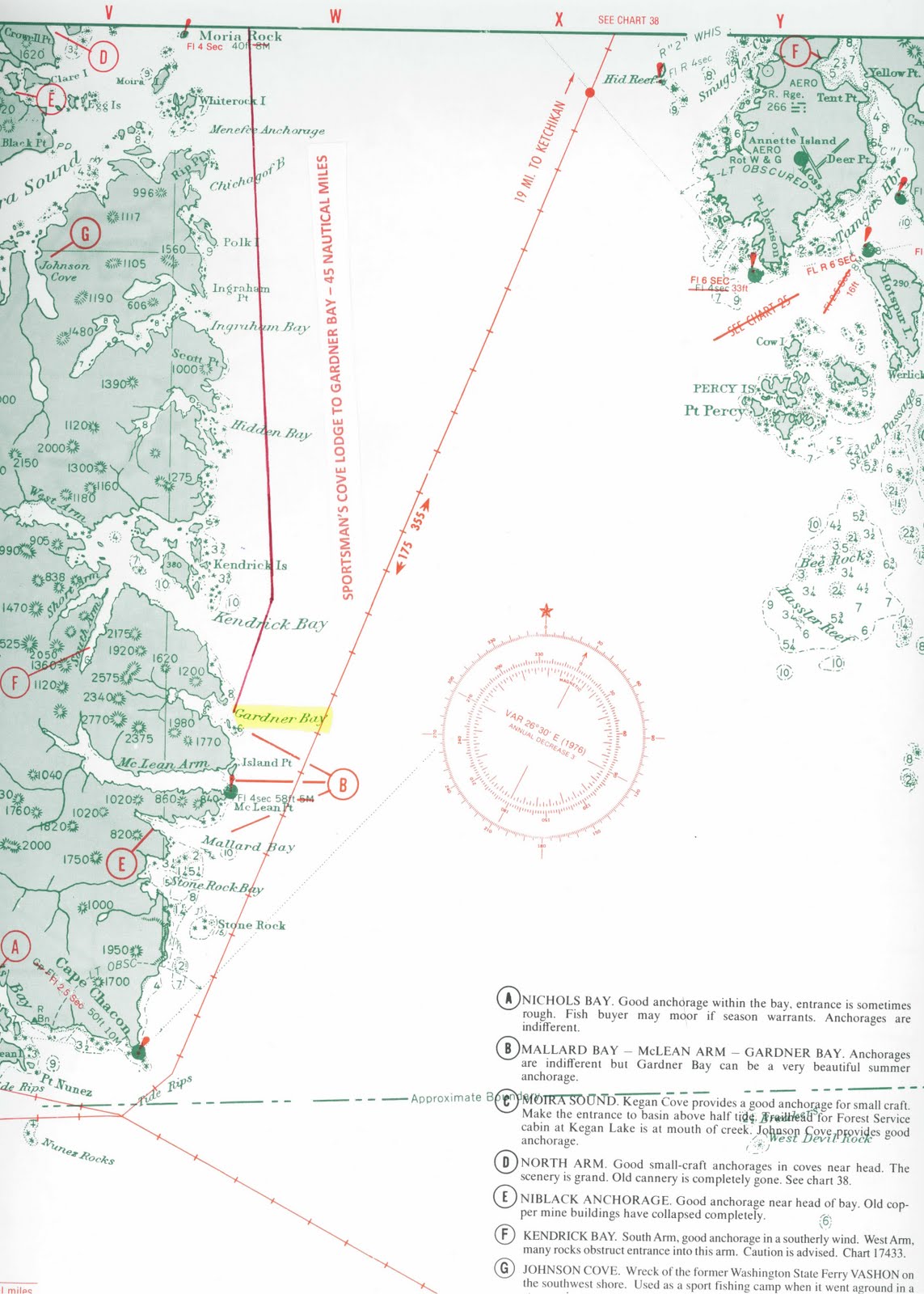 This is a chart of the southeastern tip of Prince of Wales Island, Alaska. Cape Chacon (pronounce shack-un) is the point of land at the bottom left of the illustration. The entrance to Gardner Bay is highlighted in yellow. As you can see Gardner Bay is not very big.
We don't do Cape Chacon trips very often. It is a four hour run from the Lodge so the crews take the boats down the night before and the guests fly down to join us next morning, and fly back in the afternoon. This maximizes fishing time at the Cape. Obviously it is very expensive to charter floatplanes, so there is an additional cost for the trip. It is also very weather-dependent. This is the exposed open ocean, not like our protected Inside Passage waters back at the Lodge. We don't go unless there is an absolute guarantee of good weather, both for flying and fishing. So, when we do go, it is a spectacular trip.
The fishing isn't necessarily any better at the Cape. I have often come back from a Cape Chacon trip to learn that the boats fishing close to home out of the Lodge did far better than I. But the fishing and the environment is different. It's a wild and wooly place, above the surface of the ocean as well as below, as Jon Bender describes, and it has a charismatic attraction, a siren call, all of it's own.
It is 45 nautical miles from the Lodge to Gardner Bay and another 10 nautical miles to the Cape. The Canada/U.S. border runs only a short distance south of the Cape and is still in dispute to this day. You can click on the chart to enlarge it.
Captain Mac
Born in a small coastal town in British Columbia, Canada where the only way in or out was by boat or seaplane, I never stood a chance. My destiny was a forgone
conclusion. I was doomed to fish and fly as soon as I was able. After a stint as a pilot in the Royal Canadian Navy in the sixties, and after 34 years as an airline pilot with a major U.S. carrier, at seventy five years old I am still fishin' and flyin'. More about all that as we go, if anyone is interested
Jonathan Bender's Cape Chacon

Dawn Breaks in Gardner Bay
Foreword:
Jon Bender was a deckhand around 12 years ago at our Southeast Alaska fishing resort, Sportsman’s Cove Lodge. (See www.alaskasbestlodge.com). He was about 20 years old when he wrote this. He sent it to me a year or so ago. I have edited it only slightly to update some facts and changes in fishing regulations that have occurred since Jonathan wrote this. The trip he is describing is the third day of a four-day package. Jon has been fishing with the group for two days prior to this. I hope you enjoy his perspective, which is representative of all of the staff at the Lodge, and in particular the deckhands. I will post it in several parts.
Captain Mac
Jonathan Bender’s Cape Chacon
Part I
It’s early. Though it’s plenty light enough to function, the sun has yet to peek through the opening at the east end of the small cove. The black sea is glassy, calm. Surrounding us on three sides is a series of rocky, knobby peaks, their flattened tops dropping off precipitously into the water of the cove. This area is so often and so violently windswept that the characteristically dense forest that carpets the rest of the island has never gained much of a foothold on the bedrock. Instead, resilient chartreuse lichens contrast against dark green moss and gray-black rock. Looking around, it’s easy to visualize the glaciers that, thousands of years ago, scoured out the depression in which we are anchored, now filled by the sea.
Our four charterboats are rafted up together in Gardner Bay, about 10 miles from Cape Chacon (pronounce shack-un). The other crews are beginning to stir. I eat my breakfast while prepping the gear for the day. There’s a lot to do; things are going to get hectic. The Alaska dawn comes slowly while I work and soon we hear the sound of the floatplanes, venerable de Havilland Beavers, delivering our guests. The skilled coastal bush pilots always offer a scenic and exhilarating ride, but particularly so in this case, as they maneuver expertly to land on such a small stretch of water; but short landings are their specialty, the reason why the Beavers were consigned this day. After circling above the edge of the surrounding peaks, assessing the landing zone for wind, downdrafts and any debris that might be in the cove, they descend in an arcing approach, touch down smoothly, and once firmly on the water, raise the nose steeply to come “off the step” and slow the aircraft in as short a distance as possible. Captain Mac, watches with a critical and appreciating eye. With just a touch of envy he mutters, “Poetry in motion,
just watching these guys.” And don’t worry, they know he is watching too.


One by one, the floatplanes carefully pull alongside the outside boats of our raft. Aluminum and fiberglass don’t mix so fenders and many hands help to keep the two apart. And one by one the planes discharge their cargo of passengers, lunches and raingear and drift away before starting engines and launching off towards the entrance of the cove in a blur of noise and spray.


We pick the anchor, turn loose of the other boats and head for the opening that will take us out of the cove toward the open water beyond.
“Okay folks, it’s all business from here on out,” I announce. “You should probably get some stretching in, calisthenics; whatever your pre-workout routine.” My comments are met with some blank looks, eyes peeled open, focusing on a much-anticipated near future that’s dissolving into the present. I’d started to prepare them the previous day, but I don’t think they quite understand what they’re about to be a part of. The fun is about to begin.
To be continued...
++++++++++++++++++++++++++++++++++++++++++++++
Born in a small coastal town in British Columbia, Canada where the only way in or out was by boat or seaplane, I never stood a chance. My destiny was a forgone
conclusion. I was doomed to fish and fly as soon as I was able. After a stint as a pilot in the Royal Canadian Navy in the sixties, and after 34 years as an airline pilot with a major U.S. carrier, at seventy five years old I am still fishin' and flyin'. More about all that as we go, if anyone is interested
Subscribe to:
Posts (Atom)